 |
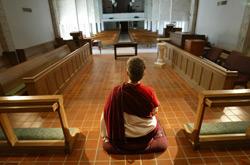
| BUDDHIST
METHOD: Rev. Annette Jones, pastor of St. John's On The Lake
First United Methodist Church, demonstrates meditation in her
church. |
Miami Herald, United States
- Armed with snacks and prizes, Audrey Bloom is trying to coax an
answer out of her 17 students.
"So who can tell me what dukkha
means?" she asks, dangling a set of golden bells from India
before a semicircle of confused faces.
"Suffering," a handful of
her adult students call out, correctly identifying the Sanskrit
term.
For the last hour, Bloom has been
illuminating the similarities between Buddhism and Christianity
at Miami's Unity on the Bay, a non-denominational Christian worship
center.
To the casual observer, the 2,500-year-old
religion of Gautama Buddha bears scant resemblance to Christianity.
But as Buddhism becomes increasingly popular in the United States
-- outpacing Episcopalianism with as many as four million members
-- a growing number of Christians are exploring Buddhist practices
while remaining within their own tradition. Christian-Buddhist meditation
groups, retreat centers, books and websites attest to the growth
of the trend.
"Times are so scary that people
are looking for spiritual discipline that offers some kind of detachment
and peace amid all this chaos," said Rita Gross, co-author
of Buddhists Talk about Jesus: Christians Talk About the Buddha
(Continuum International Publishing Group, $15.95). "People
might find a basic meditation practice very helpful, and Buddhism
is very chic right now."
But spiritual fusion isn't as easy
as whipping up Cuban Chinese or Jamaican Indian.
DIFFERENT WORLDS
On almost every level, the two doctrines
clash. Christianity holds that a divine creator fashioned the Earth
in seven days; Buddhists believe the universe -- thought to be one
of many -- has no beginning. Christian doctrine maintains the dead
will be resurrected on judgement day, while Buddhism, like Hinduism,
posits that individuals will be reborn until they achieve spiritual
liberation. And while some say Buddha and Jesus offer similar messages
of peace and compassion, one is an enlightened sage who offers a
contemplative path to liberation, the other, the sole savior.
But the glaring theological contradictions
don't impede Ruben Habito, a Zen Buddhist teacher and a practicing
Jesuit, from finding common ground between Buddhist and Christian
mystical experiences.
''There is a way one can, in a single
life, be faithful to two faiths,'' said Habito, a professor of world
religions at the Perkins School of Theology in Dallas, who recently
led a week-long meditation retreat with 35 people, and offered the
Catholic Eucharist after the evening meditation.
Prominent Buddhist leaders like the
Dalai Lama and Vietnamese monk Thich Nhat Hanh have written about
the shared goals of the two faiths, as well as Christian authors.
But it's not just scholars and religious
leaders who are driving the conversation -- a quick Internet search
unveils a smattering of Christian Buddhist listservs and support
groups.
And Christian Buddhist meditation
groups have sprung up in Massachusetts, Texas, Minnesota, and Washington.
Christians who are not comfortable
in a strictly Buddhist setting seek nirvana at the Empty Bell, a
Christian Buddhist retreat center in Watertown, Mass. The center,
founded 10 years ago by Robert Jones, a Roman Catholic and Buddhist
practitioner, has attracted a Christian base of followers.
"We have all stayed in our own
tradition but been changed by Buddhism," Jones said.
The popularity of Buddhist practice
among Christians has grown substantially during the last two decades,
said John Cowan, author of Taking Jesus Seriously: Buddhist Meditations
for Christians (Liturgical Press, $16.95).
A Roman Catholic and Zen Buddhist
who teaches meditation in churches throughout the Midwest, Cowan
said it took a meditation practice to help him understand the Gospels.
'Jesus said, `The kingdom of God is
right before you but you can't see it.' A meditation practice gives
you a glimpse of that,'' he said.
Many agree it's Buddhist meditations
and chants, not doctrine, that attract Christians.
''Buddhists have a lot of good techniques,
and those techniques don't have to be tied down to Buddhist philosophy,''
said Stephen Prothero, a professor of religion at Boston University
and an expert on Buddhism in America.
It's also a matter of convenience.
Buddhist meditation centers, which have doubled to more than 1,000
in the last 15 years, vastly outnumber Christian retreat centers,
making them a draw for those seeking a contemplative spiritual practice.
MERGING PHILOSOPHIES
The Rev. Annette Jones, pastor of
St. John's On The Lake First United Methodist Church, became interested
in Buddhism while working as a pastor in Houston in 1990. A counselor
to people dying of AIDS, Jones turned to Buddhist philosophy, where
she found practical ways of dealing with death, particularly the
Buddhist doctrine of impermanence and the meditation on dying.
''I remembered from my seminary days
that Buddhism used dying as an entrance into meditation and self
growth," she said.
After getting a Ph.D. in Tibetan Buddhist
philosophy at Rice University in Houston, Jones moved to Miami Beach
in 1999 to take the pastor's post at St. John's, where she began
teaching a course on Buddhism and Christianity.
On Monday nights, Jones and up to
12 students squeeze into the church office to practice a form of
Tibetan Buddhist meditation that includes mantra recitation, yogic
breathing, and concentrating on the Tibetan letter "A."
There's little mention of Christianity.
"As far as I'm concerned, what
has to fit is the inner experience," she said.
Some seekers have entered Christianity
through Buddhism. After 15 years of Buddhist practice, Susan Postal
was baptized as an Episcopalian in 1985 after she experienced ''a
reconnection with Christianity'' during meditation. Postal, who
continues to act as a Zen meditation teacher, said a number of her
students are practicing Catholics, and several are lapsed Catholics.
Many are apprehensive about meditating
at first, she said. ''When they first come to the zendo, they feel
a little guilty and wonder if they're being a good Christian,"
she said. "Once they see that it's just sitting, they relax
a bit."
But some Christians disapprove of
mixing and matching Buddhist practices with Christian doctrine.
Russell Moore, the dean of the school of theology at Southern Baptist
Theological Seminary in Louisville, Ky., said the two faiths are
completely at odds.
"Those who claim to be Christian
Buddhists don't take Buddhism or Christianity very seriously,"
he said. "Christianity believes in a personal God and the resurrection
of the dead, and Buddhism totally rejects that."
Some of the congregants from Miami's
Unity on the Bay, despite their teacher's best efforts, are still
having a hard time grasping the connections.
"Buddha is a way-shower, does
that sound familiar to anyone?" Bloom prods, receiving blank
stares. Jesus, they are reminded, is also a way-shower or spiritual
teacher, according to the philosophy of Unity.
Seated next to an altar adorned with
a statue of Buddha, flowers and incense, Bloom is the picture of
patience, as serene as the Buddha himself. She queries them once
more.
"Buddhism sees itself as a practical
spirituality, does that sound familiar?"
This time, she gets a few knowing
laughs. But many seem caught up in the differences between Buddhism
and Christianity. In particular, they seem baffled by the Buddhist
concept of selflessness.
'We are told, `Know thyself,' and
Buddhism says, 'Know no self,' a member of the class, LeGrande Green,
offers cheerfully.
"So if you believe in both, you're
schizophrenic," a woman across the circle mutters. Well, it's
only their second class.
|